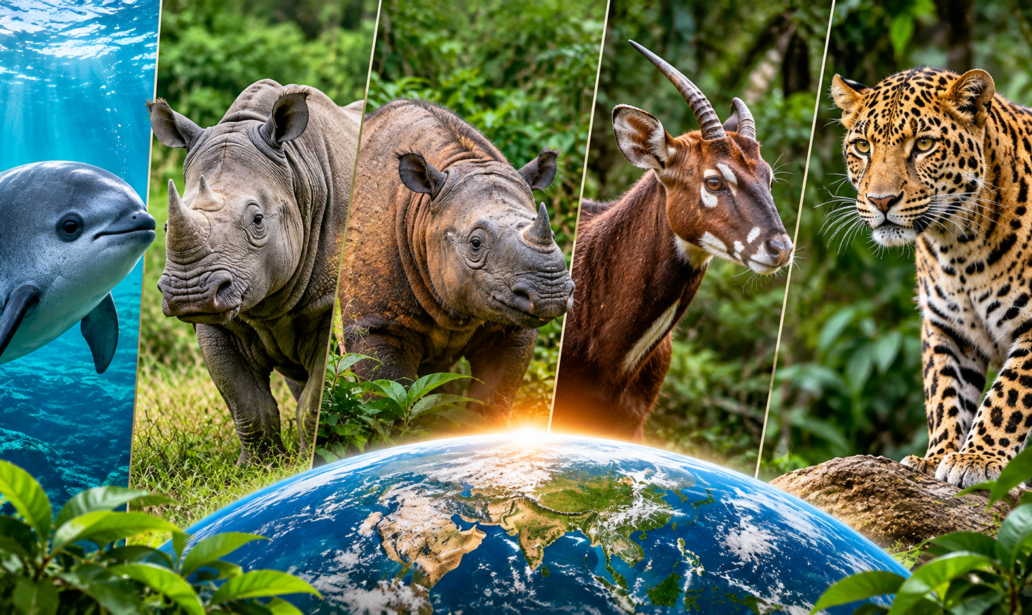
Some animals are so close to disappearing that every remaining individual matters. The vaquita, Javan rhinoceros, Sumatran rhinoceros, saola, and Amur leopard are among the world’s most critically endangered species—each facing an extremely high risk of extinction in the wild.
“Critically Endangered” is the highest threat category on the IUCN Red List for species still found in the wild. It means a species has a very small population, a rapidly shrinking range, or severe threats that could wipe it out in a short time.
1. Vaquita
The vaquita is a tiny porpoise found only in the northern Gulf of California, Mexico. It is widely considered the world’s rarest marine mammal, with recent estimates suggesting fewer than 10 individuals may remain.
Vaquitas are accidentally caught in illegal gillnets set for totoaba fish, whose swim bladders are highly valuable in illegal wildlife trade. Even though the nets are banned, they still pose a deadly risk because vaquitas can become entangled and drown.
Protecting the vaquita requires removing illegal fishing gear from its habitat and helping local communities find sustainable ways to earn a living. Without urgent action, this small porpoise could become the first marine mammal driven to extinction by human activity in modern times.
2. Javan Rhinoceros
The Javan rhinoceros is one of the rarest large mammals on Earth. It survives mainly in Ujung Kulon National Park in Indonesia, where only around 75 individuals are believed to remain.
This species once lived across much of Southeast Asia, but habitat loss and poaching reduced its range dramatically. Today, the entire wild population depends on one protected area, making it vulnerable to disease, natural disasters, and changes in its environment.
Conservation teams use camera traps to monitor Javan rhinos and track breeding activity. Protecting and expanding safe habitat is essential because a single population in one location cannot easily recover if disaster strikes.
3. Sumatran Rhinoceros
The Sumatran rhinoceros is the smallest rhino species and one of the most threatened mammals in the world. Only about 34 to 47 individuals are thought to survive in fragmented forests on Sumatra and Borneo.
These rhinos need large, connected tropical forests with plenty of food and space to roam. Unfortunately, palm-oil plantations, logging, and human development have broken their habitat into small pieces, making it harder for them to find mates and raise young.
Sumatran rhinos also face health challenges, including infections that can be fatal. Conservation programs focus on protecting remaining forests, rescuing isolated rhinos, and supporting carefully managed breeding efforts to prevent the species from disappearing.
4. Saola
The saola, often called the “Asian unicorn,” is a shy forest-dwelling mammal found in the Annamite Mountains of Vietnam and Laos. It was only discovered by science in 1992, yet it may already be on the edge of extinction.
Fewer than 100 saolas are believed to remain in the wild. Their biggest threat is not direct hunting but indiscriminate wire snares set for other animals, such as deer and pangolins. Saolas can step into these snares and suffer fatal injuries.
Saving the saola means removing snares from remote forests and strengthening protection across Vietnam and Laos. Because so little is known about the species, researchers also need better monitoring to understand where saolas live and how many are left.
5. Amur Leopard
The Amur leopard lives in the forests of Russia’s Far East and northeast China. It is one of the world’s rarest big cats, with roughly 130 individuals remaining in the wild.
Unlike some species on this list, the Amur leopard has shown signs of recovery. Strong anti-poaching efforts, protected areas, and cross-border conservation work have helped its population slowly increase from dangerously low numbers.
However, the species is still at risk. Prey shortages, wildfires, habitat loss, and poaching can quickly reverse the progress made so far. Continued protection of forests and wildlife corridors is vital for the Amur leopard’s future.
Why These Species Matter
Critically endangered species are more than rare animals—they are important parts of healthy ecosystems. Rhinos help shape forests by feeding on plants and dispersing seeds, while predators such as Amur leopards help keep prey populations balanced.
When a species disappears, the effects can spread through the food chain. Plants, insects, other animals, and even people who depend on healthy forests and oceans can feel the impact.
How We Can Help
Protecting critically endangered species takes action at many levels:
- Support organizations that protect habitats and fund anti-poaching patrols.
- Choose products that do not contribute to deforestation or illegal wildlife trade.
- Reduce plastic use and pollution, which can harm oceans and wildlife.
- Learn about endangered species and share accurate information with others.
- Support policies that protect forests, oceans, and wildlife corridors.
The vaquita, Javan rhino, Sumatran rhino, saola, and Amur leopard remind us that extinction is not just a future problem—it is happening now. With strong protection, community support, and global awareness, some of these species may still have a chance to recover.