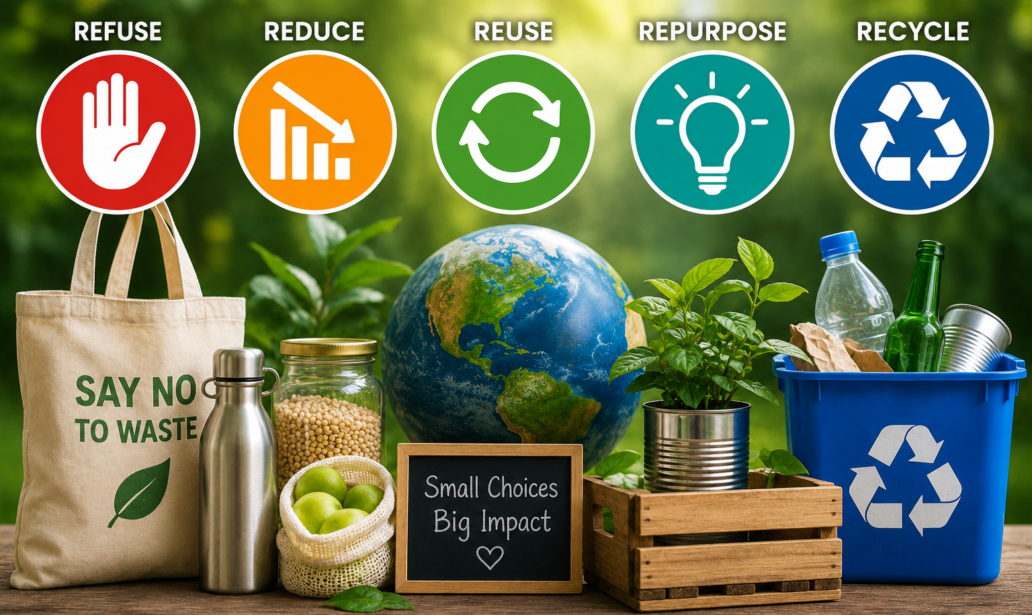
The 5 R’s to save the environment are Refuse, Reduce, Reuse, Repurpose, and Recycle. These simple actions help us prevent waste, conserve natural resources, protect wildlife, and create cleaner communities.
Many people know the familiar phrase “Reduce, Reuse, Recycle,” but the 5 R’s take the idea a step further. They encourage us to think about our choices before we buy, use, or throw away something. Instead of treating recycling as the first solution, the 5 R’s remind us to avoid creating waste whenever possible.
The order matters. Refusing unnecessary items is better than buying them and recycling them later. Reducing consumption is better than constantly replacing products. Reusing and repurposing items can extend their useful life, while recycling helps recover materials that can no longer be used in their original form. This approach follows the general waste-management principle that preventing waste and reusing products are environmentally preferable to recycling or disposal.
Why Are the 5 R’s Important?
Every product we use requires materials, energy, water, transportation, and labor. A simple plastic container, for example, may involve extracting raw materials, manufacturing the container, transporting it to a store, and eventually managing it as waste.
When we constantly buy new items and throw away old ones, we create more demand for natural resources. We may also contribute to air pollution, water pollution, greenhouse gas emissions, and overflowing landfills.
The 5 R’s help address these problems by encouraging responsible consumption. They can:
- Reduce the amount of waste sent to landfills.
- Conserve water, energy, trees, minerals, and other natural resources.
- Lower pollution caused by manufacturing and transportation.
- Protect oceans, rivers, soil, and wildlife.
- Save money by encouraging people to buy less and use items longer.
- Support cleaner and healthier homes, schools, offices, and communities.
The best part is that you do not need to make drastic changes overnight. Small habits, such as carrying a reusable water bottle or refusing unnecessary packaging, can become meaningful environmental actions when practiced consistently.
The 5 R’s
1. Refuse Unnecessary Items
The first R is Refuse. It means saying “no” to products, packaging, or services that you do not need.
Refusing is considered the first step because it prevents waste before it is created. If you do not accept a disposable item in the first place, there is no need to store it, reuse it, recycle it, or throw it away later.
Common examples include refusing:
- Plastic straws when you can drink without one.
- Disposable utensils when reusable utensils are available.
- Extra shopping bags when you already have a reusable bag.
- Free promotional items that you are unlikely to use.
- Printed receipts when a digital receipt is suitable.
- Excessive product packaging.
- Single-use cups, plates, and containers.
- Clothing or household items bought only because they are on sale.
Refusing does not mean rejecting everything. It means becoming more thoughtful about what enters your home. Before accepting or purchasing something, ask yourself, “Do I really need this?” and “What will happen to it when I am finished using it?”
For example, imagine ordering a small item online and receiving it in a large box filled with plastic wrapping, paper, and air pillows. You may not be able to control all the packaging, but you can choose sellers that offer minimal packaging or combine several purchases into one shipment.
You can also refuse products made with unnecessary or difficult-to-manage materials. When possible, choose items with little packaging, refillable containers, or durable designs.
Refusing can be challenging because advertisements often encourage impulse buying. Stores may also offer free items that seem harmless. However, “free” does not always mean useful. If an item will quickly become clutter or trash, declining it is a practical way to protect the environment.
2. Reduce What You Use
The second R is Reduce. It means using fewer resources and avoiding unnecessary consumption.
Unlike refusing, which focuses on saying no to items you do not need, reducing focuses on using less of what you already buy or consume. It can involve reducing food waste, water use, electricity consumption, fuel use, clothing purchases, and disposable products.
Here are simple ways to reduce waste at home:
- Plan meals before shopping to avoid buying more food than you can eat.
- Buy only the amount you need.
- Choose concentrated or refillable products.
- Use digital documents instead of printing whenever possible.
- Turn off lights, fans, and appliances when they are not needed.
- Repair leaking faucets and pipes.
- Take shorter showers and avoid letting water run unnecessarily.
- Choose durable products instead of cheap items that break quickly.
- Purchase fewer but better-quality clothes.
- Avoid replacing electronics simply because a newer model is available.
Reducing also means using products efficiently. For example, you can reduce paper waste by writing on both sides of a sheet. You can reduce water use by turning off the faucet while brushing your teeth. You can reduce energy use by using natural light during the day.
Food reduction is especially important. Wasted food also means wasted water, farmland, energy, packaging, transportation, and labor. To reduce food waste, store food properly, check what you already have before shopping, and use leftovers creatively. A small amount of extra rice can become fried rice, while vegetables that are no longer fresh enough for a salad may still work well in soup.
The goal is not to make life uncomfortable. The goal is to avoid waste while still meeting your needs. The U.S. Environmental Protection Agency explains that source reduction can conserve resources and energy, reduce pollution, lower waste toxicity, and save money for households and businesses.
3. Reuse Items Again and Again
The third R is Reuse. It means using an item more than once instead of throwing it away after a single use.
Reuse is one of the easiest ways to save the environment because it extends the life of products. When an item is reused, fewer new products need to be manufactured. This helps reduce the demand for raw materials and lowers the amount of waste created.
Examples of reuse include:
- Carrying a reusable shopping bag.
- Using a refillable water bottle.
- Bringing a reusable coffee cup.
- Reusing glass jars for food storage.
- Using durable food containers instead of disposable plastic bags.
- Donating clothes, books, furniture, and appliances.
- Borrowing tools or equipment instead of buying items used only occasionally.
- Using washable towels instead of disposable paper towels.
- Refilling containers whenever a safe refill option is available.
- Repairing shoes, bags, furniture, and electronics.
Reuse can also include sharing. If you only need a ladder once or twice a year, borrowing one from a family member or neighbor may be more practical than purchasing one. Community libraries, tool-sharing groups, secondhand stores, and donation centers all support reuse.
Buying secondhand is another useful option. A pre-owned desk, jacket, bicycle, or appliance can continue serving its purpose without requiring the production of a brand-new replacement. You may also find unique and affordable items while keeping usable products out of landfills.
Reusing does require care. Wash food containers properly, inspect products for damage, and follow safety instructions. Some items, such as certain plastic containers, may not be designed for repeated use or heating. Responsible reuse means using products in ways that are safe and suitable.
The main question to ask is, “Can I use this again?” Before throwing something away, consider whether it can be cleaned, repaired, donated, exchanged, or used by someone else.
4. Repurpose Items Creatively
The fourth R is Repurpose. It means finding a new use for an item after it is no longer useful for its original purpose.
Repurposing is sometimes called upcycling. It can prevent waste while encouraging creativity and practical problem-solving. An item does not always need to be used exactly as the manufacturer intended. With a little imagination, it may become something useful again.
Here are examples of repurposing:
- Turning glass jars into containers for spices, buttons, or office supplies.
- Using an old shirt as a cleaning cloth.
- Transforming wooden crates into shelves.
- Making a planter from an old bucket or cracked container.
- Using cardboard boxes to organize drawers.
- Turning worn towels into pet bedding.
- Using empty cans as pencil holders.
- Converting an old ladder into a bookshelf.
- Using wine corks for craft projects or plant labels.
- Turning leftover fabric into reusable gift wrapping.
Repurposing can be simple or artistic. You do not need expensive tools or advanced crafting skills. Sometimes the most useful solution is also the easiest. An old container can hold small household items, while a sturdy box can organize children’s toys.
Repurposing also gives people a chance to personalize their surroundings. Instead of buying another decorative item, you can create something that fits your home and reflects your style. This can make environmental living more enjoyable rather than restrictive.
Before repurposing an item, consider its condition and material. Avoid using containers for food if they previously held chemicals or harmful substances. Remove sharp edges, clean materials thoroughly, and make sure the finished item is safe.
Repurposing is especially helpful for objects that cannot easily be recycled. A broken chair may become a garden decoration, and an old bedsheet may become fabric for repairs. Even when an item is damaged, some parts may still have value.
5. Recycle Materials Properly
The fifth R is Recycle. Recycling means collecting, sorting, and processing used materials so they can be made into new products.
Common recyclable materials may include:
- Paper and cardboard.
- Glass bottles and jars.
- Metal cans.
- Certain plastic containers.
- Electronic waste through approved collection programs.
- Some types of textiles and clothing.
- Organic waste through composting programs.
However, not everything placed in a recycling bin can actually be recycled. Rules vary by location, recycling facility, and collection provider. A material may be technically recyclable but not accepted by your local program.
To recycle properly:
- Check your local recycling guidelines.
- Keep recyclable materials clean and dry.
- Empty food and drink containers before placing them in the bin.
- Separate materials when required.
- Do not place plastic bags in curbside recycling unless your local program accepts them.
- Keep food waste, liquids, and hazardous materials out of recycling bins.
- Take batteries, electronics, paint, and chemicals to suitable collection points.
- Avoid “wish-cycling,” which means recycling items simply because you hope they are accepted.
Contamination is a major problem in recycling. A greasy pizza box, wet paper, or food-covered container can make other materials difficult to process. When unsure, check the rules instead of guessing.
Recycling is valuable, but it should not be treated as permission to consume endlessly. Recycling still requires transportation, energy, processing, and infrastructure. That is why the 5 R’s place refusal, reduction, reuse, and repurposing before recycling.
The EPA identifies recycling as a way to conserve resources, save energy, prevent some air and water pollution, supply materials to industry, and reduce the need for new landfills and incinerators. Recycling works best when it is combined with responsible buying and waste prevention.
How to Apply the 5 R’s Every Day
The 5 R’s become easier when applied to ordinary routines. You can use them while shopping, cooking, cleaning, working, and traveling.
While Shopping
Bring reusable bags and containers when appropriate. Choose products with minimal packaging, buy durable items, and consider secondhand options. Avoid purchasing something simply because it is discounted if you do not have a clear use for it.
In the Kitchen
Plan meals, store food properly, and use leftovers. Choose reusable containers and avoid disposable plates, cups, and utensils when possible. Separate recyclable materials and compost food scraps if a suitable program is available.
At Home
Repair items before replacing them. Donate useful belongings instead of throwing them away. Reuse jars, boxes, paper, and fabric for storage or household projects.
At Work or School
Use digital files when practical, print only what is necessary, and keep reusable supplies on hand. Bring a refillable bottle and lunch container. Set up clearly labeled bins if your workplace or classroom has a recycling program.
During Events
Plan gatherings with reusable plates, cups, and utensils. If disposable products are necessary, choose options that can be managed through your local waste system. Prepare realistic amounts of food so less is wasted.
A Simple 5 R’s Checklist
Before buying or throwing away an item, ask:
- Refuse: Do I need this item at all?
- Reduce: Can I use less of it or choose a smaller amount?
- Reuse: Can I use it again in the same way?
- Repurpose: Can I give it a different useful purpose?
- Recycle: If I cannot use it anymore, can it be recycled properly?
This checklist turns environmental protection into a practical decision-making habit. It can be used for everything from a plastic container to an old electronic device.
What Is the Difference Between Reuse, Repurpose, and Recycle?
Reuse means using an item again for its original purpose. For example, using a water bottle repeatedly is reuse.
Repurpose means using an item for a different purpose. Turning an old bottle into a plant container is repurposing.
Recycle means processing the material so it can become part of a new product. Sending a suitable glass bottle to a recycling facility is recycling.
These actions are related, but they are not identical. Reuse and repurpose usually keep an item in use without industrial processing, while recycling breaks materials down or processes them into raw materials for manufacturing.
Can the 5 R’s Really Make a Difference?
Yes. Individual actions may seem small, but they influence purchasing habits, household waste, community cleanliness, and business practices. When many people choose reusable products, avoid unnecessary packaging, repair belongings, and recycle correctly, the combined effect can be significant.
The 5 R’s also encourage people to think beyond the trash bin. Environmental protection begins before a product is purchased and continues throughout its useful life. Preventing waste in the first place is generally more effective than managing it after it has already been created.
Businesses can apply the same principles by reducing packaging, designing durable products, offering refill systems, repairing equipment, donating surplus goods, and creating clear recycling procedures. Schools and communities can support the 5 R’s through waste-segregation programs, clean-up activities, swap events, composting, and environmental education.
No one follows the 5 R’s perfectly every day, and perfection is not the goal. The goal is to make better choices more often. Start with one change, such as refusing disposable bags or carrying a reusable bottle. Once that habit becomes easy, add another.
The 5 R’s To Save The Environment
Refuse, Reduce, Reuse, Repurpose, and Recycle provide a simple guide for living with less waste. They help us make thoughtful choices, protect natural resources, reduce pollution, and keep useful materials in circulation for longer.
Refuse what you do not need. Reduce what you use. Reuse items whenever possible. Repurpose things that still have value. Recycle materials correctly when no better option remains.
Saving the environment does not always require dramatic action. Sometimes it begins with a shopping bag, a repaired item, a leftover meal, or a container used one more time. Small choices may not feel powerful on their own, but together they can help create a cleaner, healthier, and more sustainable future.