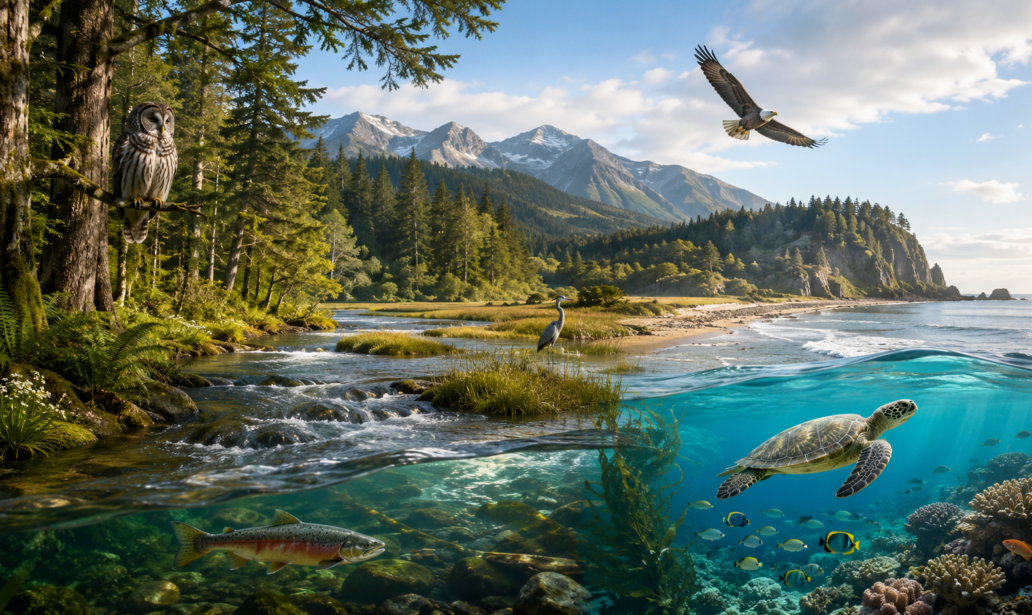
Critical habitats are special places that support the survival and recovery of threatened or endangered species. These areas contain the resources—like food, shelter, breeding sites, and migration pathways—that species need to live and reproduce. Protecting critical habitats helps keep ecosystems balanced, preserves biodiversity, and supports conservation efforts so species can recover instead of sliding toward extinction.
Key takeaways
- Critical habitats are places essential for the survival and recovery of threatened or endangered species.
- Identification relies on science, legal frameworks, and stakeholder input.
- Protection uses a mix of legal designation, management, restoration, and community engagement.
- Climate change and land-use conflicts add complexity, so adaptive, landscape-scale planning is important.
- Individuals, landowners, and communities can play concrete roles in protecting critical habitats.
Why critical habitats matter
- They directly support species survival. Without the right places to live, reproduce, and feed, many species cannot persist.
- They protect ecosystem functions. Critical habitats often overlap with wetlands, forests, coral reefs, and other systems that clean water, store carbon, and support human livelihoods.
- They guide conservation action. Identifying critical habitats focuses limited resources where they’ll help species most.
- They influence land-use decisions. When areas are designated or recognized as critical, development and activities there may be restricted or modified to reduce harm.
How critical habitats are defined
A critical habitat is typically defined by law or science-based conservation policy. While definitions vary by country, common elements include:
- The presence of physical or biological features essential to the species’ life processes (nesting sites, prey abundance, specific vegetation).
- Areas required for recovery of the species, not only for short-term survival.
- Geographic areas that may need special management or protection.
Authorities often combine field surveys, species life-history studies, and habitat modeling to delineate boundaries. Designation can be for aquatic zones, terrestrial areas, or both.
Types of critical habitat features
- Breeding and nesting sites: Beaches, caves, tree cavities, riverbanks, and other locations where animals reproduce.
- Feeding grounds: Grasslands, reefs, estuaries, and forests that support prey or plant food sources.
- Migration corridors: Rivers, flyways, and land passages that species use seasonally.
- Refugia: Safe areas used during stress events (droughts, fires, storms).
- Nursery areas: Shallow waters, floodplains, or sheltered bays where juveniles grow safely.
Who decides and how the process works
- Governments: Many countries have laws that require identifying and protecting critical habitats for listed species. Agencies run scientific reviews and public consultations.
- Scientists and conservationists: Researchers collect data on species’ needs and map habitats using tools like GIS, remote sensing, and field studies.
- Local communities and stakeholders: Indigenous groups, landowners, and local governments often contribute knowledge and help implement protections.
- Courts and policy-makers: Legal frameworks determine how protections are applied and enforced.
Common criteria used in selection
- Legal status of the species (threatened, endangered).
- Essential life stages supported (e.g., breeding, migration).
- Rarity or uniqueness of the habitat.
- Degree to which the habitat contributes to recovery goals.
- Feasibility of protection and management.
How critical habitats are protected
Protection approaches vary by jurisdiction and context, but typical measures include:
- Legal designation: Laws can restrict destructive activities in critical habitats or require mitigation.
- Habitat management: Active restoration, invasive species control, prescribed burns, or waterflow management to maintain conditions.
- Conservation agreements: Voluntary partnerships with landowners to conserve habitat.
- Protected areas: National parks, reserves, or marine protected areas may overlap with critical habitats.
- Offsetting and mitigation: When impacts are unavoidable, developers may be required to restore or protect equivalent habitat elsewhere.
- Monitoring and enforcement: Regular surveys and legal enforcement ensure measures are effective.
Examples of critical habitat in practice
- Coral reefs designated to protect spawning grounds for fish and marine invertebrates.
- Wetlands identified as critical for migratory birds and amphibian breeding.
- Old-growth forest patches preserved as nesting and feeding grounds for rare owl species.
- River stretches mapped as salmon spawning and juvenile rearing habitat.
- Coastal dunes protected because they host rare plant species and shield inland areas from storms.
Common misunderstandings clarified
- Not all important habitats are “critical.” Critical habitats are specifically essential for listed species’ survival or recovery.
- Designation doesn’t always mean no activity. Some sustainable uses may continue under conditions designed to prevent harm.
- Critical habitat is about the habitat’s role, not just the species. Protecting habitat benefits many other species and ecological processes.
- It’s not only about current use. Areas needed for future recovery, migration shifts, or climate resilience can be considered critical.
How climate change affects critical habitats
Climate change is shifting habitat suitability and species ranges, which complicates designation and protection:
- Species may need new habitats or migration pathways as temperatures and rainfall patterns change.
- Critical habitats might move, making fixed legal boundaries less effective.
- Conservation planners increasingly consider climate refugia—areas likely to remain suitable despite climate change.
- Adaptive management, landscape connectivity, and protecting diverse habitat types help build resilience.
What happens after designation
- Management plans are developed to guide conservation actions and allowable uses.
- Monitoring tracks species populations, habitat condition, and threats.
- Restoration projects may repair degraded areas—planting native vegetation, removing barriers, or restoring natural water flows.
- Stakeholder engagement ensures local people understand protections and benefit from conservation (ecotourism, stewardship programs).
How individuals can help protect critical habitats
- Support habitat-friendly practices: Reduce pesticide use, plant native species, and protect local wetlands and woodlands.
- Get involved in citizen science: Monitoring programs for birds, amphibians, and pollinators provide valuable data.
- Advocate for smart land-use policy and responsible development near sensitive areas.
- Support conservation groups working to acquire, restore, or manage critical habitats.
- Respect protected areas: Follow rules, stay on trails, and avoid disturbing wildlife.
Practical tips for landowners near critical habitats
- Request a habitat assessment to understand which species use your land.
- Implement buffer zones: Maintain native vegetation strips along waterways and edges.
- Manage invasive species and restore native plants to improve habitat quality.
- Time activities (mowing, logging) to avoid breeding seasons.
- Use conservation easements or incentive programs that reward habitat stewardship.
- Work with local agencies to create customized management plans.
Measuring success: recovery goals and indicators
Success is measured by biological and habitat-based indicators:
- Population trends: Increasing or stable numbers of the listed species.
- Reproduction rates: Successful breeding and juvenile survival.
- Habitat condition: Quality metrics like native plant cover, prey abundance, or water quality.
- Connectivity: Functional corridors that enable movement between habitat patches.
- Threat reduction: Lowered rates of habitat loss, pollution, or invasive species.
Challenges and trade-offs
- Conflicting land uses: Development, agriculture, and infrastructure can overlap with critical habitats.
- Limited funding: Conservation resources are finite, so prioritization is necessary.
- Data gaps: Insufficient information about species’ needs can delay protection.
- Enforcement: Legal protections require monitoring and political will to enforce.
- Dynamic ecosystems: Changing climates and land uses require flexible, adaptive strategies.
A short case study: Salmon and river habitats
Pacific salmon need cool, clean rivers with gravel beds for spawning and shallow, protected rearing areas for juveniles. Forestry, damming, and water withdrawals can degrade these features. Identifying critical river stretches led to regulations that limit timber harvest near riparian zones, fish passage improvements at barriers, and restoring floodplain connectivity. Over time, these targeted actions helped increase spawning success and juvenile survival, demonstrating how protecting habitat features directly supports species recovery.